Catch your reflection in a shop window and you might notice it before you feel it. The shoulders have rolled a little further forward. The upper back has taken on a soft curve. The head sits ahead of the body instead of stacked above it. This gentle forward rounding creeps up on most of us as the years pass, and it is not your imagination. It is one of the most common posture changes after the age of fifty.
The encouraging part is that a great deal of this rounding is not set in stone. Much of it comes from tight muscles across the chest and weakness in the upper back, both of which respond well to gentle, consistent care. And one of the simplest tools for that care is something already sitting in your bathroom. A rolled bath towel and five quiet minutes a day can help open the chest, coax the upper spine back toward its natural shape, and leave you standing a little taller.
This is the upper back version of the Japanese towel exercise, and it is wonderfully suited to older adults. There is no equipment to buy, no floor routine to memorize, and no strain involved. You simply lie down and let gravity do the work.
What the Japanese towel exercise is
The method comes from Dr. Toshiki Fukutsuji, a Japanese practitioner who studied posture and spinal alignment and shared his approach in a book that became a runaway bestseller across Asia. The idea is disarmingly simple. You lie on your back over a rolled towel, hold a relaxed position for a few minutes, and let the gentle support of the towel encourage your spine and ribcage back toward better alignment. It is a passive stretch, which means you are not pushing or pulling. You are resting while the position works quietly on your behalf. For a fuller introduction to the method, including its history and honest limits, see our complete guide to the Fukutsuji method.
Most people first hear about the towel placed under the lower back. That version is excellent for the lumbar region and for everyday back tension, and we cover it in full in our guide to the towel stretch for back pain. The article you are reading now focuses on a different placement and a different goal. By positioning the towel higher up, under the upper back and between the shoulder blades, you target the part of the spine that rounds forward over time and the chest muscles that pull the shoulders inward. That makes this version especially useful for posture and rounded shoulders.
This approach fits a wider Japanese idea called yōjō, the practice of caring for the body through small, steady daily habits rather than waiting for problems to grow large. Five minutes is not a lot to ask, and the steadiness is what brings the results.
Why posture rounds forward as we age
Understanding why the upper back curves helps you appreciate why the towel helps. Several quiet changes tend to arrive together.
The chest muscles, the pectorals across the front of the shoulders, gradually tighten. Decades of reaching forward, whether for a steering wheel, a kitchen counter, a book, or a phone, encourage these muscles to shorten. Tight chest muscles pull the shoulders inward like a drawstring.
At the same time the muscles of the upper back, the ones that hold the shoulder blades down and back, tend to weaken if they are not used. When the front is tight and the back is weak, the shoulders win the tug of war and roll forward.
The spine itself has a natural gentle curve in the upper back, called the thoracic curve. With age, reduced bone density, and long hours of sitting, this curve can deepen into a more pronounced rounding. In its more advanced form this is sometimes called kyphosis, and many people know the most visible version of it as a rounded upper back or a forward hunch.
This matters for more than appearance. A rounded upper back can crowd the lungs and make full breathing feel harder. It can shift your center of balance forward, which over time affects steadiness on your feet. It can add strain to the neck as the head juts ahead of the body, and it can quietly chip away at confidence. Gently reversing what is reversible is well worth the small daily effort.
How the towel placement changes the effect
The same towel can do two different jobs depending on where you put it.
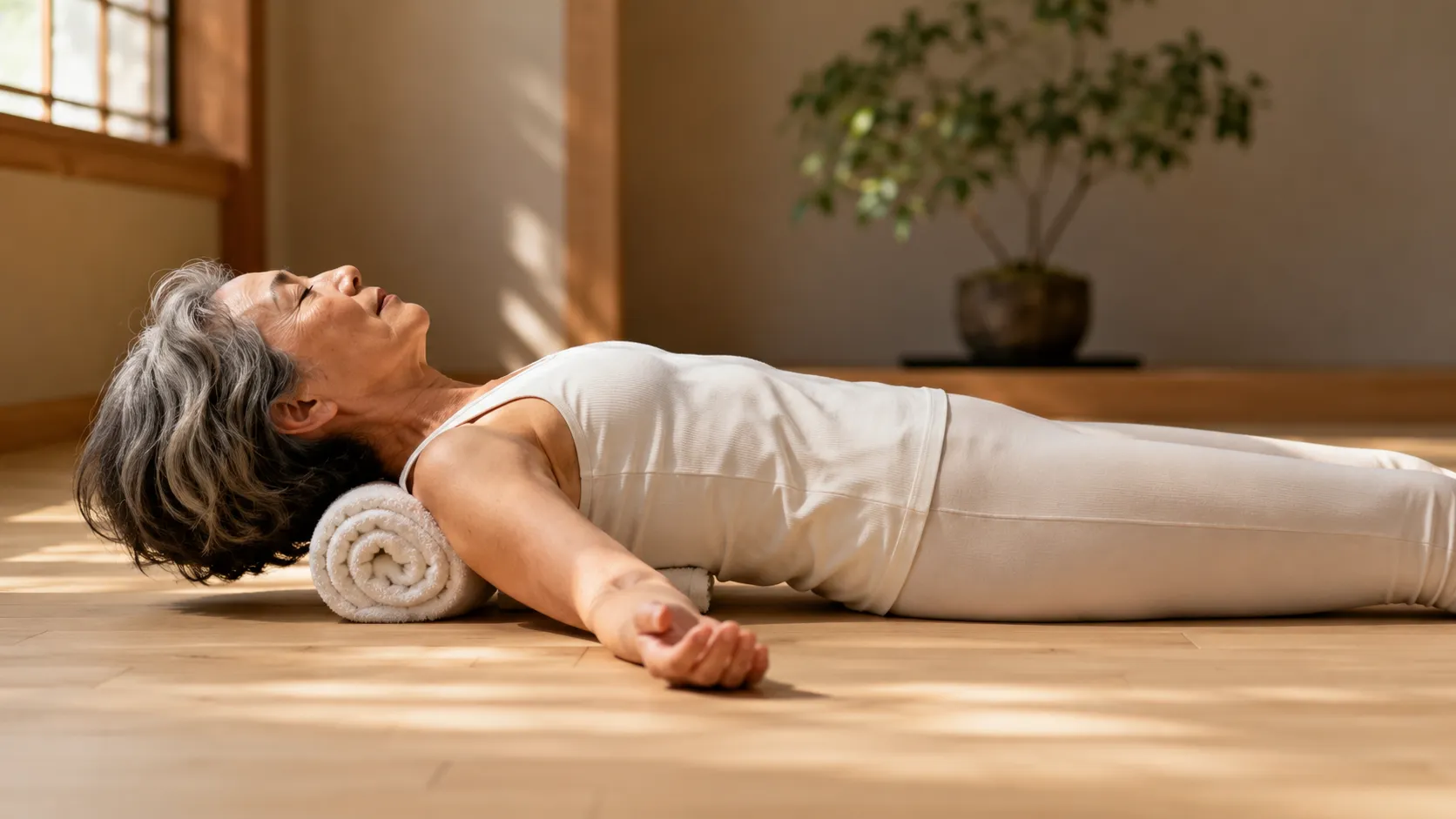
When the roll sits under the lower back, it supports the lumbar curve and helps with the pelvis and lower back tension. When the roll sits higher, under the upper back across the line of the shoulder blades, it acts almost like a gentle fulcrum. Your chest is invited to open over the top of the roll, the tight pectoral muscles get a slow passive stretch, and the upper spine is encouraged to extend rather than round. Letting your arms rest out to the sides deepens that chest opening without any effort on your part.
It is this upper placement that makes the difference for rounded shoulders, and it is the version we will walk through step by step.

The benefits of the upper back towel position for seniors
A few minutes a day in this position can offer several gentle benefits over time.
It opens the chest and counters the forward roll of the shoulders, which is the most direct effect and the reason it suits posture work so well. It gives tight chest muscles a slow, passive stretch without any strain on your part. It encourages the upper spine to extend, which can help you feel taller and more upright when you stand. Because the chest opens, many people find that a slow breath feels a little fuller and easier in this position. And it asks almost nothing of you physically, which makes it accessible even on days when energy is low or joints are stiff.
It is worth being honest about what it is and is not. This is gentle maintenance, not a medical treatment, and it works best as a steady habit rather than a one time fix. We look at each of these benefits more closely, and at the claims that do not hold up, in our guide to the benefits of the Japanese towel method. Postural rounding that comes from tight muscles responds well. Rounding that comes from changes in the bones of the spine is a different matter and belongs with your doctor, which we will return to in the safety section.
What you will need
You need very little. A single bath towel works for most people, although a smaller hand towel or a thinner folded towel is a kinder starting point if you are new to this or if your upper back feels stiff. You also need a firm, flat surface such as a carpeted floor or a yoga mat. A bed is usually too soft to give the right support. A timer is helpful so you can simply close your eyes and relax rather than watching a clock. That is the entire kit.
How to roll the towel
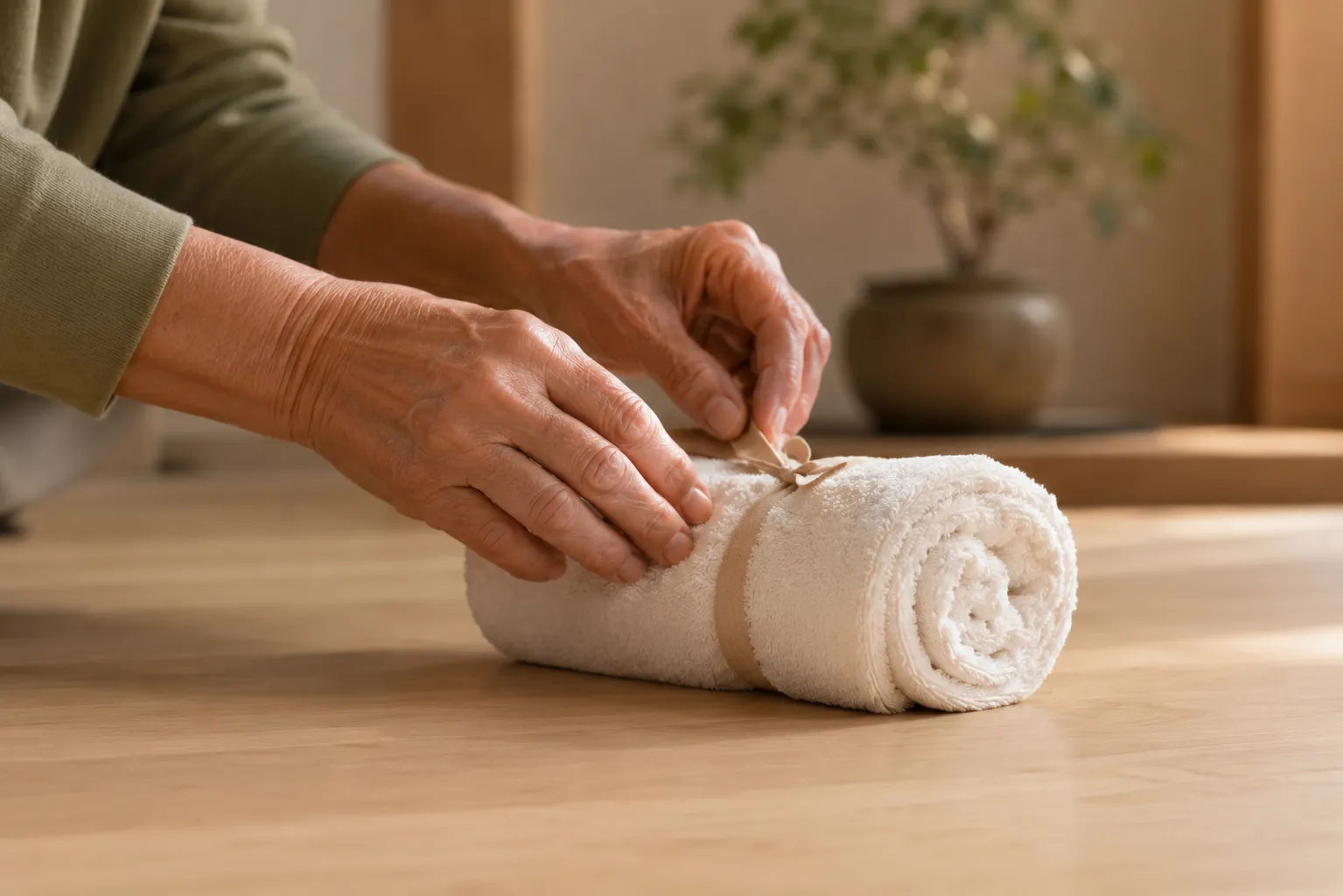
Lay the towel flat and roll it tightly from one of the short ends into a firm cylinder. For the upper back position, aim for a roll that is roughly the thickness of your forearm, somewhere around five to eight centimeters across. Start on the thinner side. You can always build up to a thicker roll as your chest and upper back become more open over the weeks.
To keep the roll from unwinding, tie it in two places with a ribbon, a length of string, or two hair ties. A neatly secured roll holds its shape and gives you steady, even support.
How to do the towel exercise for posture, step by step

Take it slowly the first few times. The position should feel like a mild, pleasant stretch across the chest, never anything sharp.
Place the rolled towel on your flat surface, lying horizontally so it will sit across your back rather than along your spine.
Sit down in front of the roll and gently lower yourself back so that the towel comes to rest under your upper back, roughly along the line where a bra strap sits, between the shoulder blades. This is higher than the lower back placement you may have read about. If the roll feels too high near the neck, slide your body up a little so it settles lower, between the shoulder blades.
Let your head rest on the floor. If reaching the floor with your head feels like a strain, place a thin folded towel under your head for support. Keep your knees bent with your feet flat on the floor to begin with, since this is the gentlest version. As you grow more comfortable over time you can extend your legs out straight.
Let your arms fall open. Rest them out to the sides at a comfortable angle, palms facing up toward the ceiling. This open arm position invites the chest to broaden and gives the front of the shoulders a slow, passive stretch. If resting your arms overhead feels good and pain free, you may try that instead, but out to the sides is the easier starting point.
Settle in and breathe slowly through the nose. Let your shoulders soften toward the floor with each exhale. Begin with just one or two minutes the first few times, then build gradually toward five minutes as the position becomes familiar and comfortable.
When your time is up, this is the most important step. Do not sit straight up from the position. Instead, gently slide the towel out from under you or roll onto your side first, and then use your hands to push yourself up to sitting. Rising slowly protects your back and prevents the lightheaded feeling that can come from getting up too quickly.
If you would also like to give the lower back a turn, you can repeat the same routine with the roll positioned under the lower back at the level of your navel. The upper back placement is the one to prioritize for rounded shoulders and posture.
A simple daily routine
Consistency is the quiet engine behind this method, so an easy rhythm matters more than a long session.
A gentle starting routine looks like this. Practice once in the morning and once in the evening. Begin with one to two minutes per session in the first week. In the following weeks, add a little time until you are resting comfortably for around five minutes. If five minutes twice a day suits you, that is plenty. Some people enjoy a third short session in the middle of the day, especially after long hours of sitting.
Pairing the towel position with a few slow breaths turns it into a calming pause as much as a posture exercise. Many readers like to follow it with the gentle hara breathing exercises we cover separately, which deepen the sense of an open, relaxed chest.
Safety and who should take extra care
This is a gentle practice, but a thoughtful one. Please read this section before you begin.
Speak with your doctor first if you have
- • Osteoporosis or low bone density
- • A recent or healing fracture
- • Spinal stenosis or significant scoliosis
- • Recent surgery on your spine, hips, or shoulders
Lying over a firm roll places gentle pressure along the spine, and for some conditions that pressure needs medical clearance and a softer setup. When in doubt, ask.
Begin with a thinner, softer roll than you think you need. You can always build up. A thicker roll too soon is the most common reason the position feels uncomfortable rather than pleasant.
The sensation you are looking for is a mild stretch across the chest and a feeling of opening. Sharp pain, pins and needles, numbness, or dizziness are signals to stop. Come out of the position slowly and rest.
Always rise slowly, rolling to your side first, to protect your back and avoid lightheadedness.
Finally, remember the honest limits of the method. It is supportive daily care for the muscles that influence posture. It is not a cure for structural changes in the bones of the spine, and it does not replace the guidance of a medical professional.
Common mistakes to avoid
A few small adjustments make all the difference.
- • Using too thick a roll too soon. Start thin and progress slowly.
- • Placing the towel under the neck rather than the upper back. The roll belongs between the shoulder blades, not up against the base of the skull.
- • Holding your breath. Slow, easy breathing is part of what lets the chest open.
- • Sitting straight up at the end. This is the one most worth fixing, since rolling to your side first protects your back.
- • Expecting overnight change. Posture took years to round forward, and it softens back gradually with patient, regular practice.
Combine it with other gentle Japanese practices
The towel exercise works beautifully as part of a small daily wellness habit rather than in isolation. If you enjoy it, you might explore the Makko Ho stretches for gentle whole body flexibility, the asa no taiso morning routine to start the day with easy movement, or the calming practice of hara breathing. For the lower back specifically, our towel stretch for back pain guide covers the lumbar placement in detail. Together these form a kind, low effort routine that supports posture, breathing, and steadiness through the years.
Frequently asked questions
How long until I notice a difference in my posture?
Most people who practice daily begin to feel a little more open through the chest within the first week or two. Visible changes in how you stand tend to come more gradually over several weeks of consistent practice. Posture responds to patience rather than intensity.
Can I do the towel exercise on my bed?
A bed is usually too soft to give the steady support the position needs. A carpeted floor or a yoga mat works much better. If getting down to the floor is difficult, speak with a physical therapist about a safe alternative.
Is this the same as the towel exercise for a slimmer waist?
It uses the same Fukutsuji method, but the focus here is different. We concentrate on posture and rounded shoulders rather than the waistline claims you may have seen online. Those waist slimming claims are widely overstated, so we keep our attention on the genuine benefit, which is gentle support for posture and chest openness.
How often should I do it?
Once or twice a day is ideal, working up to around five minutes per session. A short third session after long sitting is fine if you enjoy it. More is not better, so there is no need to overdo it.
Can it help a rounded upper back or a forward hunch?
It can gently help when the rounding comes mainly from tight chest muscles and a weak upper back, which is common and very responsive. Rounding that comes from changes in the bones of the spine is a different situation that should be assessed by your doctor. The towel work can often sit alongside medical care as a gentle daily habit, with your doctor's agreement.
A small habit that pays off
Standing a little taller does not require a gym, a program, or a struggle. It asks for a rolled towel, a quiet five minutes, and the willingness to come back to it tomorrow. That gentle steadiness, the heart of the Japanese idea of yōjō, is exactly what helps the chest open, the shoulders settle back, and the years rest a little more lightly on your frame.
Roll up a towel, find a soft patch of floor, and give your posture five quiet minutes today.