Imagine having the power to relieve your own headaches, boost your energy, improve your digestion, and ease chronic pain, all without medications, expensive treatments, or special equipment. This isn't wishful thinking. It's Do-In, a traditional Japanese self-massage technique that has been used for over a thousand years to maintain health and vitality.
Do-In (導引) combines acupressure, stretching, and breathing exercises to stimulate your body's natural healing abilities. The name comes from Chinese characters meaning "to guide" (導) and "to stretch" (引): essentially, the art of guiding your body's energy through conscious movement and touch.
Unlike acupuncture or professional massage therapy, Do-In can be performed by yourself, anywhere, anytime. It requires no special equipment, costs nothing, and takes just 10-20 minutes a day. For seniors and people dealing with chronic stiffness, pain, or low energy, Do-In offers a gentle yet powerful way to take control of your health.
What Is Do-In? Understanding Japanese Self-Massage
Do-In is based on the same principles as acupuncture and Traditional Chinese Medicine (TCM). According to this ancient healing system, life force energy (called "qi" or "ki" in Japanese) flows through your body along specific pathways called meridians.
When this energy flow becomes blocked or imbalanced, it can manifest as chronic pain, fatigue, digestive problems, headaches, poor circulation, sleep disturbances, and general malaise. By applying pressure to specific points along these meridians with your fingers, you can release energy blockages, restore natural balance, and activate your body's self-healing mechanisms.
The Philosophy Behind Do-In
Energy Blockages Cause:
- • Chronic pain and stiffness
- • Fatigue and low energy
- • Digestive problems
- • Headaches and tension
- • Poor circulation
- • Sleep disturbances
Acupressure Restores:
- • Natural energy flow
- • Balance and harmony
- • Healthy circulation
- • Self-healing mechanisms
- • Reduced inflammation
- • Improved organ function
Why Japanese Acupressure Is Different
While Do-In shares principles with Chinese acupressure and reflexology, the Japanese approach has some distinctive characteristics:
Gentleness Over Force
Japanese acupressure emphasizes subtle, sustained pressure rather than deep, painful manipulation. The philosophy is that gentle, consistent stimulation is more effective for promoting energy flow.
Integration with Daily Life
Do-In was designed to be incorporated into your morning routine, like brushing your teeth. It's meant to be a preventive daily practice rather than just a treatment for when problems arise.
Whole-Body Approach
Rather than focusing solely on problem areas, Do-In treatments typically work through the entire body systematically, recognizing that everything is interconnected.
Emphasis on Self-Sufficiency
While Western medicine often creates dependency on practitioners, Do-In empowers you to maintain your own health. You become your own healer.
Essential Do-In Acupressure Techniques
The Basic Pressure Method
The fundamental technique in Do-In involves applying steady, focused pressure to specific points (called "tsubo" in Japanese) using your fingertips, thumbs, or palms.
How to Apply Pressure:
- 1. Locate the acupressure point (you'll often feel a slight depression or tender spot)
- 2. Place your finger or thumb on the point
- 3. Apply firm but gentle pressure, enough to feel it but not cause pain
- 4. Hold for 5-10 seconds while breathing deeply
- 5. Release slowly
- 6. Repeat 3-5 times per point
Pressure Guidelines: Use about the same pressure you'd use to test a ripe avocado. If you feel sharp pain, you're pressing too hard.
Tapping
Light rhythmic tapping with fingertips stimulates energy flow and wakes up sluggish areas. Tap for 30-60 seconds per area.
Kneading
Grasp muscle tissue between fingers and thumb, gently rolling and kneading. Great for releasing tension in larger muscles.
Rubbing
Rub palms together vigorously until warm, then place over specific areas. The heat has therapeutic properties in Japanese medicine.
Key Acupressure Points for Daily Practice
Here are some of the most important and accessible acupressure points you can work on daily:
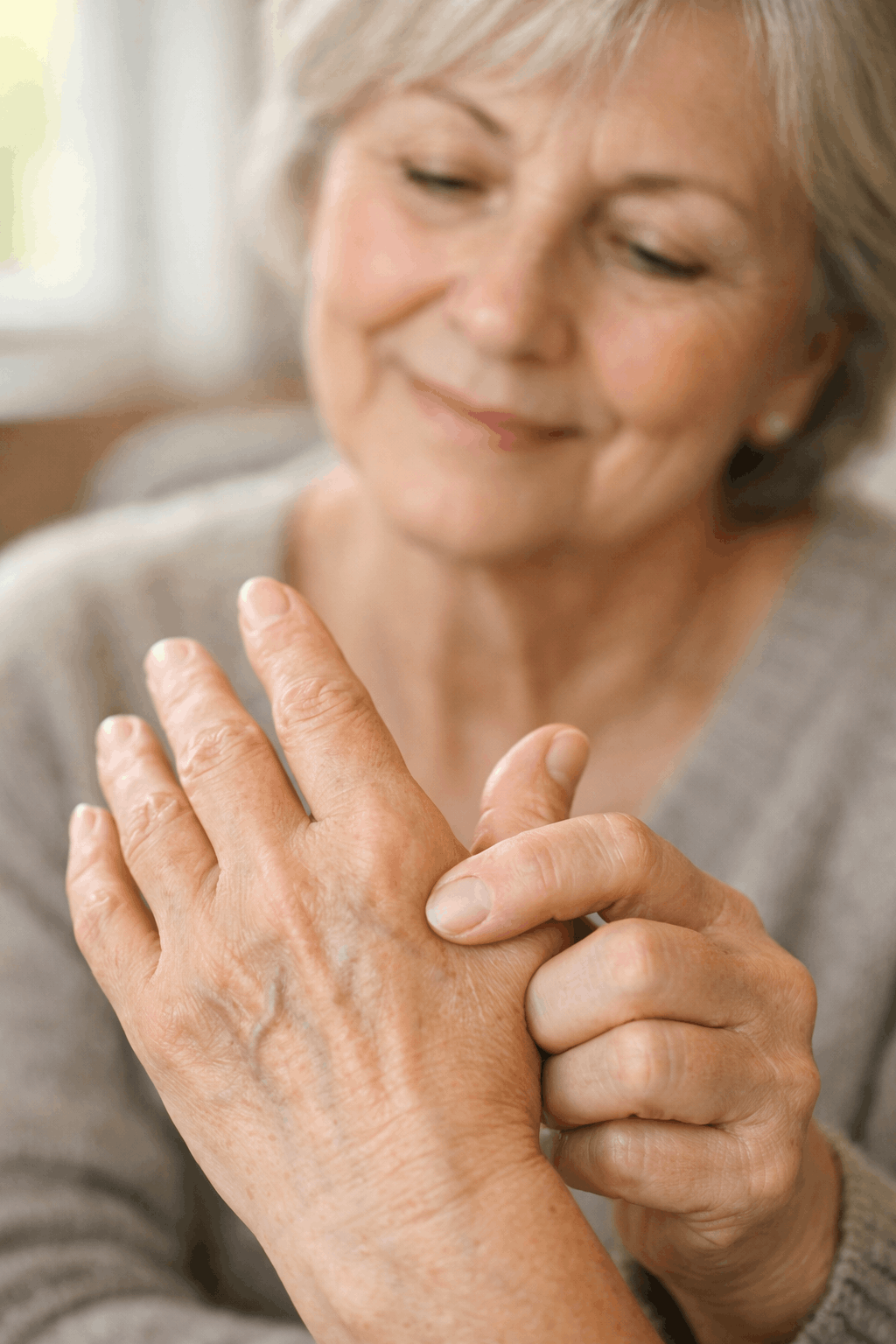
1. Hegu (Large Intestine 4) - "Joining Valley"
Location: In the webbing between your thumb and index finger, at the highest point of the muscle.
Benefits:
- • Relieves headaches and facial pain
- • Reduces stress and anxiety
- • Alleviates neck and shoulder tension
- • Boosts immune function
How to Use:
Press firmly for 1-2 minutes on each hand. You should feel a mild ache radiating through your hand.
Note: Do not use during pregnancy.
2. Zusanli (Stomach 36) - "Leg Three Miles"
Location: Four finger-widths below the kneecap, one finger-width to the outside of the shinbone.
Benefits:
- • Boosts energy and stamina
- • Strengthens the immune system
- • Aids digestion
- • Supports knee and leg health
How to Use:
Press firmly for 2-3 minutes on each leg. Traditionally gives you energy to "walk three more miles."
3. Yintang - "Hall of Impression" (Third Eye Point)
Location: Directly between your eyebrows, in the indentation where the bridge of the nose meets the forehead.
Benefits:
- • Relieves headaches and sinus pressure
- • Calms the mind
- • Improves concentration
- • Reduces insomnia
How to Use:
Use index or middle finger to apply gentle, circular pressure for 1-2 minutes.
4. Neiguan (Pericardium 6) - "Inner Gate"
Location: Three finger-widths up from the wrist crease on the inner forearm, between the two tendons.
Benefits:
- • Relieves nausea and motion sickness
- • Reduces anxiety and palpitations
- • Helps with insomnia
- • Calms upset stomach
How to Use:
Press firmly with thumb for 1-2 minutes on each arm. Used in acupressure wristbands for seasickness.
5. Baihui (Governing Vessel 20) - "Hundred Convergences"
Location: At the highest point of your head, in the center. Draw an imaginary line from the tops of both ears. Where they meet is Baihui.
Benefits:
- • Relieves headaches
- • Improves mental clarity
- • Reduces dizziness
- • Lifts mood and energy
How to Use:
Use middle finger to apply gentle pressure or tap lightly for 1-2 minutes.
A Complete Do-In Morning Routine (15 Minutes)
This 15-minute morning routine will energize your entire body and set a positive tone for the day.
1. Wake Up Your Face (3 minutes)
- Facial Tapping: Tap lightly all over face with fingertips (forehead, cheeks, jaw). Include area around eyes gently.
- Eye Exercises: Rub palms together until warm, cup over closed eyes for 30 seconds.
- Yintang Point: Press gently between eyebrows for 1 minute.
- Jaw Release: Place fingers on jaw muscles, open and close mouth while massaging.
2. Energize Head & Neck (3 minutes)
- Scalp Massage: Use all fingertips in small circular motions across entire scalp.
- Baihui Point: Press crown point for 1 minute.
- Neck Release: Tilt head to one side, knead exposed neck muscle with opposite hand. Repeat both sides.
- Shoulder Squeeze: Squeeze and release trapezius muscles.
3. Activate Arms & Hands (2 minutes)
- Arm Stimulation: Tap down inside of arm from shoulder to palm, then up outside from hand to shoulder. Repeat other arm.
- Hegu Point: Press web between thumb and finger on each hand.
- Finger Massage: Massage each finger from base to tip, rotate gently.
- Shake: Shake hands vigorously.
4. Energize Your Core (3 minutes)
- Abdominal Massage: Rub palms until warm, place on lower abdomen. Make slow clockwise circles 30-50 times.
- Kidney Tapping: Make loose fists, tap gently on lower back where kidneys are for 1 minute.
- Chest Opening: Tap across chest, including area above and below collarbones.
5. Activate Legs & Feet (4 minutes)
- Leg Stimulation: Sit on edge of chair. Tap down outside of leg from hip to ankle, up inside from ankle to groin. Repeat other leg.
- Zusanli Point: Press point below kneecap for 1 minute each leg (the "endurance point").
- Foot Massage: Massage sole of each foot with thumbs, focusing on arch and ball.
- Ankle Rotation: Rotate ankles in both directions, flex and point feet.
Do-In for Specific Health Concerns
For Headaches
- 1. Yintang (Third Eye): Press between eyebrows for 2 minutes
- 2. Taiyang (Temples): Circle temples with fingertips
- 3. Hegu (Hand Web): Press firmly for 2 minutes each hand
- 4. Finish with gentle scalp massage
For Lower Back Pain
- 1. Kidney Tapping: Tap lower back with loose fists for 2 minutes
- 2. Weizhong: Press center of back of knee
- 3. Knead lower back muscles thoroughly
- 4. Zusanli: Press to strengthen back's foundation
For Digestive Issues
- 1. Abdominal Massage: Clockwise circles for 5 minutes
- 2. Zhongwan: Press point midway between navel and breastbone
- 3. Zusanli: Press for digestive support
- 4. Neiguan (Wrist): For nausea
For Anxiety & Stress
- 1. Yintang (Third Eye): Calms the mind
- 2. Neiguan (Wrist): Reduces anxiety
- 3. Shenmen (Heart Point): On wrist crease in line with pinky
- 4. Deep breathing while pressing each point 2-3 minutes
Do-In pairs well with other gentle Japanese practices. If your lower back feels stiff from sitting, the Japanese towel method (Fukutsuji) lets gravity open up the spine while you lie still for a few minutes. And because every Do-In point is held while you breathe slowly, the Japanese long breath method is a natural companion to your practice.
Safety Considerations and Contraindications
When to Be Cautious:
Avoid During:
- • Pregnancy (especially Hegu and Sanyinjiao points)
- • Active infections or fever
- • Immediately after meals (wait 30 minutes)
- • Intoxication
Be Cautious With:
- • Varicose veins (use very light pressure)
- • Broken or inflamed skin
- • Recent surgery or injuries
- • Osteoporosis (use gentle pressure)
When to Seek Medical Care: Do-In is not a substitute for medical treatment. Consult a healthcare provider for severe or persistent pain, new or unexplained symptoms, or any concerns about your health.
The Science Behind Acupressure
While Do-In is based on traditional energy medicine, modern research has begun to validate its effects:
Pain Relief
Studies show acupressure triggers release of endorphins, the body's natural painkillers.
Stress Reduction
Acupressure lowers cortisol levels and activates the parasympathetic nervous system.
Improved Circulation
Pressure on specific points increases local blood flow with systemic circulation effects.
Neurological Effects
Brain imaging shows acupressure modulates pain perception and emotional processing.
Frequently Asked Questions About Do-In
What is do-in massage?
Do-In is a traditional Japanese form of self-massage. You use your own fingertips, thumbs and palms to press, tap, knead and rub areas of your body, combined with slow breathing and gentle stretching. The name comes from the Chinese practice of Daoyin and means roughly "to guide and to stretch".
How long should a do-in session take?
Anything from a few minutes to about 15. A single point is held for 5 to 10 seconds and repeated 3 to 5 times, so even two or three points during a break count as practice. The full morning routine in this article takes about 15 minutes.
Is do-in safe for seniors?
For most people it is a gentle practice, as long as the pressure stays light: firm enough to feel, never painful. Use very light pressure if you have osteoporosis or varicose veins, stay away from broken skin and recent injuries, and ask your doctor first if you are pregnant or have a health condition.
What is the difference between do-in and shiatsu?
Both work with pressure on the same kinds of points. Shiatsu is given to you by a trained practitioner while you lie down. Do-In is done on yourself, so you can practise it anywhere, at any time, and you stay in control of the pressure.
Can I do do-in every day?
Yes. It is meant as a daily habit, and a few minutes each day is easier to keep up than one long session a week. Many people press a few points in the morning to wake up and a few in the evening to wind down.
Your Hands Hold Healing Power
In our modern world of pills, procedures, and specialists, we've forgotten a simple truth that the Japanese have known for centuries: your own hands are powerful healing tools. Do-In reminds us that we're not helpless in the face of aches, pains, and stress. We can take action.
This practice asks for just a few minutes of your time each day. In exchange, it offers natural pain relief, better energy and vitality, improved sleep, reduced stress and anxiety, greater body awareness, and a sense of empowerment over your health.
Do-In is not about perfection. You don't need to memorize every point or follow a strict routine. Start with what feels good. Pay attention to your body. Be gentle with yourself. Over time, you'll develop an intuitive sense of what you need.
The ancient Japanese masters taught that the journey of a thousand miles begins with a single step. Your journey to better health through Do-In begins with a single point, perhaps the Hegu point between your thumb and finger. Press it now. Feel the slight ache, the warmth, the awakening of sensation.
That's Do-In. That's healing. And it's been waiting in your hands all along.
Medical Disclaimer
This article is for informational purposes only and should not replace professional medical advice. Always consult with your healthcare provider before starting any new wellness practice, especially if you have existing health conditions or concerns.