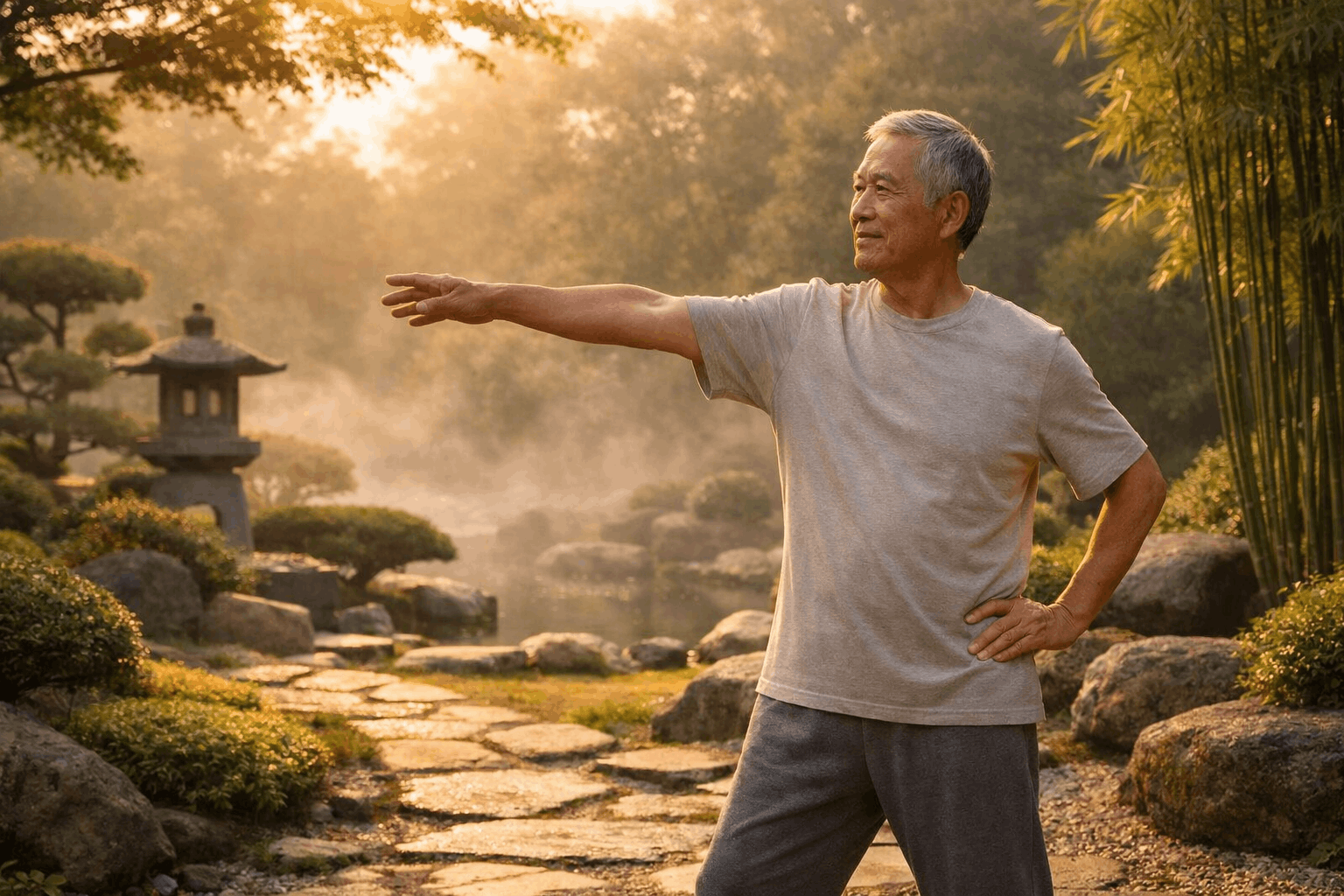
If you've ever noticed how effortlessly elderly Japanese people move (bending to tend gardens, sitting in seiza, walking for miles), you're witnessing the result of a cultural practice that begins each day: Asa no Taisō (朝の体操), literally "morning exercise."
Unlike Western morning routines that often involve rushing from bed to coffee to commute, the Japanese concept of Asa no Taisō emphasizes starting the day by awakening the body systematically through gentle, flowing movements. This isn't about aggressive stretching or pushing your limits. It's about creating harmony between body and mind before the day's demands begin.
Why Morning Stretching Helps
Older adults who establish a consistent morning stretching routine commonly report:
- Improved balance and stability throughout the day
- Greater flexibility and ease of movement
- Steadier energy and a clearer sense of focus
The practice dates back to Japan's Meiji era (1868-1912) when Western influence brought new attention to physical fitness, but the Japanese integrated their traditional concepts of ki (vital energy) and mindful movement into exercise routines. Over generations, Asa no Taisō evolved into what many consider the perfect morning ritual for maintaining vitality into old age.
The Morning Movement Philosophy
Japanese wellness traditions recognize that the body and mind are intimately connected, and how you begin your day sets the tone for everything that follows. Asa no Taisō embodies several key principles:
Kansha (感謝)
Gratitude - Each movement is an opportunity to appreciate your body's capabilities and express gratitude for another day of life.
Kokyu (呼吸)
Conscious Breathing - Every stretch is coordinated with intentional breathing, delivering oxygen to tissues and calming the nervous system.
Ma (間)
Purposeful Pausing - Rather than rushing through sequences, traditional practice includes brief pauses to notice sensations and maintain presence.
Yugami (歪み)
Addressing Imbalance - Morning is when you notice how sleep has affected your body (stiffness, asymmetry, tension) and the routine targets these imbalances.
Why Morning Stretching Matters More After 50
Overnight Changes in the Body
During sleep, several changes make morning movement particularly important for those over 50:
- • Disc rehydration imbalance: Intervertebral discs rehydrate overnight, creating temporary imbalances that cause morning stiffness.
- • Decreased circulation: Heart rate and blood pressure drop during sleep, reducing circulation to extremities.
- • Cortisol spike: Cortisol peaks 30-45 minutes after waking. Gentle stretching moderates this response.
- • Fascia adhesions: The fascial system develops micro-adhesions during stillness. Morning stretching breaks these before they become fixed.
The Complete Asa no Taisō Routine
This 10-12 minute sequence follows traditional Japanese progression from head to toe, gentle to more dynamic, always maintaining breath awareness.
Phase 1: Awakening (2 minutes) - Standing
Purpose: Transition from sleep state to movement state, establish breath rhythm, center awareness
1. Gasshō (合掌) - Palm Press with Breath Awareness
Stand with feet hip-width apart, knees soft. Bring palms together at chest height.
- • Inhale for 4 counts: Feel chest and ribcage expand
- • Hold for 2 counts: Notice stillness
- • Exhale for 6 counts: Feel gentle compression of palms
- • Repeat 5 times
2. Katakuru Mawashi (肩車回し) - Gentle Shoulder Circles
Keep feet grounded, palms still pressed together.
- • Inhale: Circle shoulders backward and up toward ears
- • Exhale: Release shoulders down and forward
- • Continue 8 circles backward, then 8 circles forward
3. Kubi no Undō (首の運動) - Neck Awakening
- • Look right, hold 3 breaths, return center
- • Look left, hold 3 breaths, return center
- • Tilt right ear toward shoulder, hold 3 breaths
- • Tilt left ear toward shoulder, hold 3 breaths
- • Do NOT roll head in full circles
Phase 2: Spinal Mobility (3 minutes) - Standing
Purpose: Restore full spinal range of motion after night's compression
4. Karada Nobashi (体伸ばし) - Sky Reach
- • Inhale: Raise both arms overhead, reaching toward ceiling
- • Exhale: Rise onto toes (or stay flat if balance is challenging)
- • Hold for 3 breaths, feeling length through entire spine
- • Repeat 5 times
5. Sokumen Nobashi (側面伸ばし) - Side Bends
- • Inhale: Lengthen spine upward
- • Exhale: Bend right, sliding hand down thigh
- • Feel stretch along entire left side
- • Hold 3 breaths, repeat each side 3 times
6. Karada Hineri (体ひねり) - Spinal Rotation
- • Arms extended forward at shoulder height
- • Exhale: Rotate torso right, arms move as one unit
- • Hold 3 breaths, maintaining hip stability
- • Complete 5 rotations each side
7. Zengo Kushin (前後屈伸) - Forward Fold to Backbend Flow
- • Inhale: Arms overhead, gentle back arch (10-15 degrees)
- • Exhale: Hinge at hips, fold forward, let arms dangle
- • Hold for 3 breaths, feeling hamstrings release
- • Inhale: Slowly roll up, one vertebra at a time
- • Repeat 3 times
Phase 3: Lower Body Activation (3 minutes)
Purpose: Improve leg circulation, strengthen stabilizers, enhance balance
8. Ashi no Katsuyaku (足の活躍) - Leg Awakening Series
Use a wall or chair for balance support.
- • Marching: Lift knee, hold 3 counts, lower. 10 each leg.
- • Leg extensions: Extend leg forward, flex foot, hold 3 counts. 5 each leg.
9. Kakato Age Sage (踵上げ下げ) - Heel Raises
- • Stand facing wall for fingertip support
- • Inhale: Rise onto toes, lifting heels high
- • Hold 3 counts, exhale: Lower with control
- • Complete 15 repetitions
10. Ashikubi Mawashi (足首回し) - Ankle Circles
- • Circle each foot clockwise 10 times
- • Circle counterclockwise 10 times
- • Point and flex each foot 10 times
Phase 4: Hip Opening (2 minutes)
Purpose: Restore hip mobility critical for walking, stairs, and preventing falls
11. Momo Age (腿上げ) - Hip Flexor Stretch
- • Step right foot forward into lunge position
- • Keep back leg straight
- • Gently press hips forward
- • Hold 30 seconds each side, repeat twice
12. Ashi Furi (足振り) - Leg Swings
- • Forward/back: Swing leg gently like pendulum, 15 swings each
- • Side swings: Swing leg out to side and across body, 15 each
- • Keep torso stable, small controlled movements
Phase 5: Integration & Gratitude (2 minutes)
Purpose: Integrate all movements, transition to daily activities mindfully
13. Zensin Shindō (全身振動) - Whole Body Shake
- • Begin gently bouncing, knees soft
- • Let bouncing travel up: hips, spine, shoulders, jaw
- • Keep arms loose, swinging naturally
- • Continue 30-60 seconds, gradually slow to stillness
14. Kansha no Kokyu (感謝の呼吸) - Gratitude Breathing
Return to standing, hands at heart. Take 5 deep breaths, each time thinking of something you're grateful for.
Time-Based Variations
5-Minute Express Version
- • Gasshō Palm Press (30 sec)
- • Shoulder Circles (30 sec)
- • Sky Reach (45 sec)
- • Side Bends (1 min)
- • Spinal Rotation (1 min)
- • Heel Raises (45 sec)
- • Gratitude Breathing (30 sec)
20-Minute Extended Version
- • Add Makko-Ho stretches between Phase 3-4
- • Include Hara breathing at the beginning
- • Extend holds from 3 to 5-8 breaths
- • Add Fukutsuji towel stretch at the end
What Consistent Morning Practice Can Deliver
Immediate Effects (Single Session)
- • Cardiovascular awakening: Heart rate gently rises, circulation improves, and breathing deepens.
- • Mental clarity: Many people feel more alert and ready to focus after just a few minutes of movement.
- • Joint mobility: Stiffness eases as the joints warm up and fluid moves through the tissues.
Cumulative Benefits (4+ Weeks)
- • Flexibility gains: Hamstrings, hips, and the spine gradually become more supple.
- • Balance improvements: Daily practice builds the small stabilizing muscles that protect against falls.
- • Less morning stiffness: Chronic lower-back and neck discomfort often eases over time.
- • Steadier mood: Mindful morning movement is widely associated with lower stress and a calmer mind.
Your 7-Day Challenge
Ready to experience the transformative power of morning movement?
- • 10 minutes every morning (set alarm 10 minutes earlier)
- • Same time each day
- • Before checking phone or computer
- • Follow the complete routine as written
Start tomorrow. Your body will thank you.
Frequently Asked Questions
Q: Should I do this before or after breakfast?
Ideally before breakfast, or at least 30 minutes after a light breakfast. Morning stretching on an empty stomach is most comfortable and allows fuller range of motion.
Q: Can I do this if I have arthritis?
Absolutely. Morning movement is one of the most effective non-pharmaceutical interventions for arthritis stiffness. Reduce range of motion to comfortable levels.
Q: Is 10 minutes really enough?
Research consistently shows that 10 minutes of daily movement provides significant benefits that 70 minutes once weekly does not. Consistency trumps duration.
Q: What if I miss a day?
Don't fall into the "all or nothing" trap. Missing one day doesn't negate your progress. Simply resume the next day without guilt.