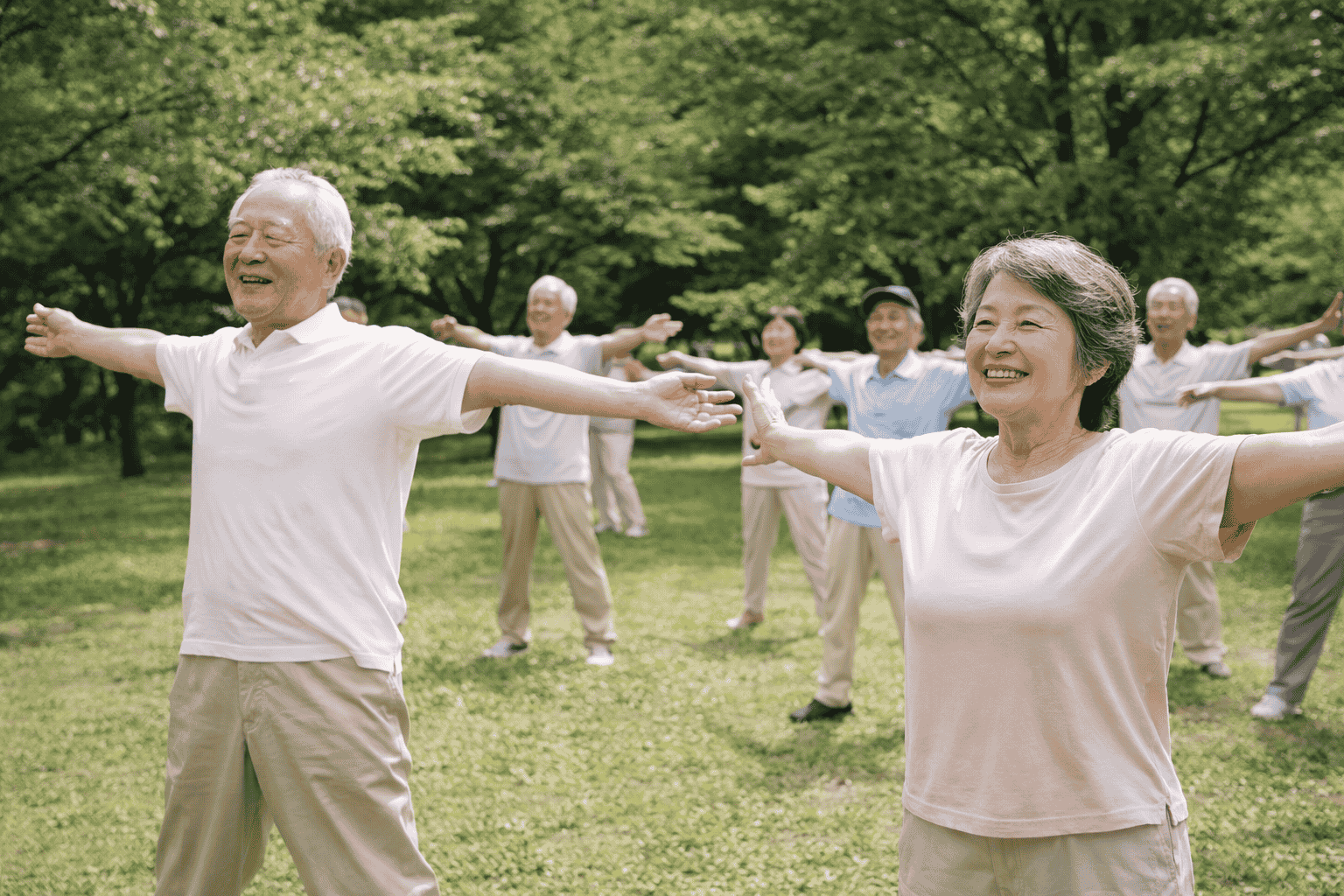
If you've ever wondered how millions of Japanese seniors maintain their mobility, balance, and independence well into their 80s and 90s, the answer might surprise you. It's not an expensive gym membership or complicated workout program. It's a simple 3-minute exercise routine called Radio Taiso that's been practiced across Japan for nearly a century.
Radio Taiso (literally "radio exercises") is a gentle calisthenics program that targets every major muscle group through 13 carefully designed movements. What makes it particularly effective for people over 50 is its focus on functional fitness: the kind of strength, flexibility, and balance you need for everyday activities like climbing stairs, reaching for objects, or simply maintaining your independence.
In this comprehensive guide, you'll learn everything you need to know about Radio Taiso, including step-by-step instructions for each exercise, the science-backed benefits for seniors, and how to incorporate this Japanese wellness tradition into your daily routine.
What Is Radio Taiso? A Brief History
Radio Taiso was introduced to Japan in 1928, inspired by American calisthenics programs. The exercises were initially broadcast over the radio (hence the name) to promote public health across the nation. Today, millions of Japanese people (from schoolchildren to retirees) perform Radio Taiso daily, often in parks, workplaces, and community centers.
The program consists of two series: Radio Taiso No. 1 (the gentler version, perfect for beginners and seniors) and Radio Taiso No. 2 (slightly more challenging). Each routine takes approximately 3 minutes to complete and requires no equipment whatsoever.
What makes Radio Taiso unique is its accessibility. The exercises are specifically designed to be performed by people of all ages and fitness levels, making it an ideal choice for seniors who want to stay active without risking injury.
Why Radio Taiso Became a National Tradition
In Japan, Radio Taiso is more than just exercise. It's a social ritual that brings communities together. Many seniors gather in parks at 6:30 AM to perform the routine as a group, fostering social connections that are crucial for mental health and longevity.
This community aspect is one reason why Japan has one of the highest life expectancies in the world. Regular physical activity combined with social engagement creates a powerful formula for healthy aging.
Science-Backed Benefits of Radio Taiso for Seniors Over 50
Research on Radio Taiso has revealed impressive benefits, particularly for older adults. Here's what the science tells us:
1. Improved Balance and Fall Prevention
Falls are the leading cause of injury among seniors, and Radio Taiso addresses this directly. The routine includes movements that gently challenge your center of gravity, helping to strengthen the stabilizing muscles that keep you upright. Practitioners often report better steadiness during everyday tasks after a few weeks of daily practice.
2. Enhanced Flexibility and Range of Motion
As we age, our muscles naturally become tighter and our joints lose flexibility. Radio Taiso combats this through dynamic stretching movements that take each joint through its full range of motion. The arm circles, torso twists, and leg swings help maintain the flexibility you need for daily activities.
3. Cardiovascular Health Without High Impact
Unlike running or jumping exercises that can be hard on aging joints, Radio Taiso provides cardiovascular benefits through low-impact movements. The routine raises your heart rate to a moderate level, enough to support heart health without causing undue stress on the body.
4. Mental Clarity and Cognitive Function
Radio Taiso requires you to remember and coordinate 13 different movements in sequence, a small but real mental workout that pairs naturally with the physical one. This combination of light cognitive challenge and gentle movement is widely believed to support memory and focus as you age.
5. Energy Boost That Lasts All Day
Many seniors who practice Radio Taiso report feeling more energized throughout the day. Morning exercise has been shown to regulate circadian rhythms, improve sleep quality, and increase overall energy levels. Starting your day with Radio Taiso can help you feel more alert and focused.
The 13 Radio Taiso Exercises: Step-by-Step Guide
Radio Taiso No. 1 consists of 13 exercises performed in sequence. Each movement flows naturally into the next, creating a seamless 3-minute routine. Here's how to perform each exercise:
Exercise 1: Arm Circles (Deep Breathing)
How to do it:
- • Stand with feet shoulder-width apart
- • Inhale as you raise both arms forward and up over your head
- • Exhale as you lower your arms down to your sides in a wide circle
- • Repeat 4 times
Benefits: Opens the chest, improves breathing capacity, and warms up the shoulder joints.
Tip for seniors: If raising your arms fully overhead is difficult, lift them as high as comfortable.
Exercise 2: Arm Swings (Chest Expansion)
How to do it:
- • Standing position, arms at your sides
- • Swing both arms forward and up, then back and down
- • On the backward swing, squeeze your shoulder blades together
- • Keep the movement rhythmic and continuous
- • Repeat 4 times
Benefits: Strengthens the upper back and improves posture by counteracting the forward slump many seniors develop.
Exercise 3: Arm Circles (Shoulder Exercise)
How to do it:
- • Extend arms out to the sides at shoulder height
- • Make small circles with your arms, rotating from the shoulders
- • Circle forward 4 times, then backward 4 times
- • Keep your core engaged and shoulders relaxed
Benefits: Increases shoulder mobility and strengthens rotator cuff muscles, essential for lifting objects.
Exercise 4: Chest Expansion with Leg Bends
How to do it:
- • Start with hands on hips
- • Bring both arms forward, then swing them back while bending your knees slightly
- • Return to starting position
- • Repeat 4 times
Benefits: Combines upper and lower body movement, improving coordination and strengthening legs.
Modification: If balance is a concern, hold onto a chair with one hand while performing the movement.
Exercise 5: Side Bends
How to do it:
- • Place right hand on hip, extend left arm overhead
- • Bend to the right, reaching your left arm over your head
- • Return to center, switch sides
- • Repeat 4 times on each side
Benefits: Stretches the obliques and improves lateral flexibility, which helps with movements like reaching sideways or turning.
Exercise 6: Forward Bend and Back Extension
How to do it:
- • Stand with feet shoulder-width apart
- • Bend forward from the hips, letting arms hang toward the floor
- • Return to standing, then lean back slightly with hands on lower back
- • Repeat 4 times
Benefits: Maintains spinal flexibility and strengthens lower back muscles.
Safety tip: Only bend as far forward as comfortable. You don't need to touch your toes.
Exercise 7: Torso Twists
How to do it:
- • Place hands on hips
- • Twist your torso to the right, then to the left
- • Keep hips facing forward. The rotation should come from your waist
- • Repeat 4 times on each side
Benefits: Improves spinal rotation, essential for activities like backing up a car or reaching behind you.
Exercise 8: Arm Movements with Leg Raises
How to do it:
- • Standing position, arms at sides
- • Raise your right arm and left leg simultaneously
- • Lower, then switch sides
- • Maintain balance by keeping your core tight
- • Repeat 4 times on each side
Benefits: Challenges balance and coordination while strengthening the core and leg muscles.
Modification: Hold onto a chair if needed. Even small leg lifts provide benefits.
Exercise 9: Front and Back Leg Swings
How to do it:
- • Hold onto a chair or wall for balance
- • Swing your right leg forward and back
- • Keep the movement controlled and rhythmic
- • Switch legs after 4 swings
Benefits: Improves hip flexibility and strengthens hip flexors, crucial for walking and climbing stairs.
Exercise 10: Toe Raises and Heel Raises
How to do it:
- • Stand with feet together
- • Rise up onto your toes, then lower
- • Rock back onto your heels, lifting toes off the ground
- • Repeat 8 times
Benefits: Strengthens calves and ankles, improving balance and preventing falls.
Exercise 11: Jumping Jacks (Modified)
How to do it:
- • For seniors, this is modified to a stepping motion
- • Step right foot out to the side while raising arms overhead
- • Return to center
- • Step left foot out and repeat
- • Perform 8 times total
Benefits: Gets your heart rate up without the impact of traditional jumping jacks.
Exercise 12: Side-to-Side Steps with Arm Swings
How to do it:
- • Step to the right, swinging arms across your body to the right
- • Step to the left, swinging arms to the left
- • Keep the movement fluid and rhythmic
- • Repeat 4 times on each side
Benefits: Improves lateral movement and coordination, important for navigating crowded spaces or avoiding obstacles.
Exercise 13: Deep Breathing with Arm Raises (Cool Down)
How to do it:
- • Stand tall, feet together
- • Slowly raise both arms overhead while inhaling deeply
- • Lower arms while exhaling completely
- • Repeat 2-3 times, focusing on your breath
Benefits: Lowers heart rate gradually and promotes relaxation after exercise.
How to Get Started with Radio Taiso
The beauty of Radio Taiso is its simplicity. Here's how to incorporate it into your daily routine:
Start with the Basics
Don't worry about perfecting every movement on day one. Focus on learning the sequence and moving your body through the motions. Proper form will come with practice.
Create a Consistent Schedule
The traditional time to practice Radio Taiso is first thing in the morning, but you can do it whenever works best for you. The key is consistency: aim for at least 5 days per week to see results.
Use Video Guides
Search for "Radio Taiso" or "Rajio Taiso" on YouTube to find official videos from Japan's postal service or NHK broadcasting. Watching these videos helps you learn the proper rhythm and form.
Find a Workout Buddy
Exercise is more enjoyable and sustainable when done with others. Consider inviting a friend, spouse, or neighbor to join you. You might even start a morning Radio Taiso group in your community park.
Listen to Your Body
Radio Taiso should feel invigorating, not painful. If any movement causes discomfort, modify it or skip it. You can gradually increase your range of motion as your flexibility improves.
Radio Taiso wakes the body up with movement. For a calm counterpart in the evening, try the Japanese towel method (Fukutsuji): you lie still over a rolled towel for a few minutes while your back and chest gently open.
Common Mistakes to Avoid
Even with such a simple routine, there are a few pitfalls to watch out for:
- Rushing Through the Movements
Radio Taiso is meant to be performed at a specific, moderate pace. Moving too quickly reduces the effectiveness and increases injury risk.
- Holding Your Breath
Many people unconsciously hold their breath during exercise, which can cause dizziness and reduce performance. Focus on breathing naturally throughout each movement.
- Skipping the Warm-Up
The first few exercises in Radio Taiso serve as a warm-up. Don't jump straight to the more challenging movements. Follow the sequence as designed.
- Expecting Overnight Results
Like any exercise program, Radio Taiso requires consistency. Give it at least 4-6 weeks before evaluating its effects. The benefits are cumulative.
What Equipment Do You Need for Radio Taiso?
One of the best things about Radio Taiso is that it requires almost nothing:
Essential Items
- • Comfortable clothing that allows full range of motion
- • Supportive athletic shoes with good grip
- • A flat, open space about 6 feet by 6 feet
Optional Helpful Items
- • A yoga mat for outdoor practice
- • A chair or wall nearby for balance support
- • A smartphone or tablet to play videos
Frequently Asked Questions About Radio Taiso
How long does Radio Taiso take? ▼
Is Radio Taiso safe for seniors with arthritis? ▼
Can I do Radio Taiso if I have balance problems? ▼
When is the best time to do Radio Taiso? ▼
How soon will I see results? ▼
Why Radio Taiso Is Perfect for Seniors Over 50
Radio Taiso addresses many of the specific challenges that come with aging:
- It's Joint-Friendly: Unlike high-impact exercises, Radio Taiso uses gentle movements that lubricate joints rather than stress them.
- It Requires No Equipment: No gym membership or special equipment needed, which makes it accessible to everyone.
- It's Time-Efficient: At just 3 minutes, Radio Taiso fits into even the busiest schedule.
- It Builds Community: When practiced in groups, it provides social interaction crucial for mental health.
- It's Time-Tested: With nearly 100 years of use across Japan, this isn't a fitness fad. It's a wellness tradition.
Start Your Radio Taiso Journey Today
You now have everything you need to begin your Radio Taiso practice. This simple 3-minute routine has the potential to transform your health, energy, and quality of life, just as it has for millions of Japanese seniors.
Remember, the hardest part of any exercise program is simply starting. Don't wait for the perfect moment or until you "feel more ready." Your future self will thank you for taking action today.
Your journey to better balance, flexibility, and vitality begins with a single session. Will today be the day you take that first step?
Medical Disclaimer
This article is for informational purposes only and should not replace professional medical advice. Always consult with your healthcare provider before starting any new exercise program, especially if you have existing health conditions or concerns.