Sotai: The Japanese Movement Therapy That Works With Your Body, Not Against It
Discover how this gentle Japanese therapy uses natural movement to relieve pain, improve posture, and restore balance, without force or strain.
Plays from YouTube. Pressing play sends data to Google. Privacy policy
Sotai (pronounced "so-tie," written as 操体法 or sōtai-hō) is a gentle Japanese movement therapy that takes a radically different approach to treating pain and stiffness. Instead of forcing your body into uncomfortable stretches or pushing through pain, Sotai asks you to move in the direction that feels comfortable and natural. This may sound counterintuitive, but it's precisely this "paradoxical" approach that makes Sotai so effective, and so safe for seniors and people with chronic pain.
Developed in the 1970s by Japanese physician Dr. Keizo Hashimoto, Sotai is based on a simple but profound observation: your body already knows how to heal itself. When you move in the direction of comfort and ease, you give your nervous system the information it needs to reset muscle tension patterns and restore natural balance.
Unlike conventional stretching that focuses on lengthening tight muscles, Sotai works by engaging muscles in comfortable directions, then releasing them to allow natural relaxation. This gentle approach makes it ideal for seniors, people recovering from injuries, and anyone dealing with chronic stiffness or pain.
The Philosophy Behind Sotai
Sotai is built on several core principles that distinguish it from Western physical therapy and even from other forms of Japanese bodywork:
Move Toward Comfort, Not Pain
In conventional stretching, you're often told to "push through" discomfort to increase flexibility. Sotai takes the opposite approach: you move only in directions that feel comfortable and natural. This might mean moving away from your painful side or choosing the easier direction when given a choice.
Why does this work? When you force a stretch into pain, your nervous system responds defensively. Muscles tighten to protect you from injury. But when you move toward comfort, your nervous system relaxes its guard, allowing natural release and rebalancing.
Minimal Effort, Maximum Effect
Sotai movements use only about 30-40% of your maximum strength. This light engagement is enough to communicate with your nervous system without triggering defensive muscle tension. After holding this gentle effort for 3-5 seconds, you release completely and allow your body to naturally rebalance.
This minimal effort approach makes Sotai accessible to people of all fitness levels, including those with severe pain or limited mobility.
The Body Seeks Balance Naturally
Sotai is based on the idea that your body has an innate drive toward balance and symmetry. When given the right conditions (comfortable movement, gentle engagement, complete release), your body will naturally correct imbalances without being forced. You're not fighting against your body or trying to force it into an ideal position. Instead, you're creating conditions that allow natural self-correction.
Pain is Information, Not an Enemy
In Sotai, discomfort and limitation aren't problems to overcome. They're valuable information about where your body needs attention. By noticing which movements feel restricted or uncomfortable, and then moving in the opposite direction, you work with your body's natural feedback system.
How Sotai Differs From Other Therapies
Understanding what makes Sotai unique helps clarify when and how to use it:
Sotai vs. Conventional Stretching
- •Conventional stretching: Lengthens tight muscles by pulling them toward their limit
- •Sotai: Engages muscles in comfortable directions, then releases to allow natural relaxation
- •Why it matters: Sotai doesn't trigger defensive muscle tension, making it gentler and often more effective
Sotai vs. Yoga
- •Yoga: Often holds positions for extended periods, sometimes near the edge of flexibility
- •Sotai: Holds gentle contractions for just 3-5 seconds, always well within comfortable range
- •Why it matters: Sotai requires less strength and flexibility, making it accessible to more people
Sotai vs. Physical Therapy
- •PT: Often focuses on strengthening specific muscles or increasing range of motion
- •Sotai: Focuses on resetting nervous system patterns and restoring natural balance
- •Why it matters: Sotai addresses the root cause (nervous system patterns) rather than just symptoms
Sotai vs. Chiropractic
- •Chiropractic: Practitioner manipulates joints to correct alignment
- •Sotai: Your own gentle movements allow natural realignment
- •Why it matters: You control the process, making it extremely safe
The Basic Sotai Technique
Every Sotai movement follows the same basic structure. Once you understand it, you can apply it to virtually any area of the body.
Assess
Find a position or movement that feels restricted, uncomfortable, or unbalanced. For example, turning your head left might feel tight while turning right feels easy.
Move Toward Comfort
Instead of moving toward the restriction, move in the direction that feels easy and comfortable. If left feels tight, turn your head to the right.
Add Gentle Resistance
While holding this comfortable position, add light resistance (about 30-40% effort). Think "gentle isometric contraction" rather than forceful pushing.
Hold Briefly
Maintain this gentle resistance for 3-5 seconds. Breathe naturally and don't hold your breath.
Release Completely
Let go all at once and relax completely for several seconds. This sudden release is crucial. It allows your nervous system to reset.
Reassess
Return to neutral position and check the original restriction. Often, it will have reduced significantly or disappeared entirely.
Sotai Exercises for Common Problems
Remember: always move in the comfortable direction and use only 30-40% effort.

For Neck Pain and Stiffness
Side-to-Side Neck Rotation
- 1.Sit comfortably with good posture
- 2.Turn your head left and right, noticing which direction feels easier
- 3.Turn toward the easy direction (let's say it's right)
- 4.Place your right hand on your right cheek
- 5.While holding your head turned right, gently try to turn further right while your hand provides light resistance
- 6.Hold this gentle "pushing" for 3-5 seconds
- 7.Release suddenly and relax for 5-10 seconds
- 8.Return to center and retest. The left side should now turn more easily
- 9.Repeat 2-3 times
Forward-Backward Neck Tilt
- 1.Sit with good posture
- 2.Tilt your head forward (chin toward chest) and backward (looking up), noticing which feels easier
- 3.If looking up feels easier, tilt your head back to a comfortable degree
- 4.Place your hands on your forehead and gently press your head upward and backward while your hands provide light resistance
- 5.Hold 3-5 seconds, then release completely. Relax for 5-10 seconds, then retest
- 6.Repeat 2-3 times
Side Neck Bend
- 1.Tilt your head toward your left shoulder, then toward your right, noticing which is easier
- 2.Tilt toward the easier side (let's say right)
- 3.Place your right hand on the right side of your head
- 4.Gently press your head further right while your hand resists
- 5.Hold 3-5 seconds, release, relax. Repeat 2-3 times

For Shoulder Pain and Tension
Shoulder Elevation Exercise
- 1.Sit or stand comfortably
- 2.Raise both shoulders toward your ears, noticing if one lifts more easily
- 3.If your right shoulder lifts more easily, focus on that side
- 4.Raise your right shoulder partway up (comfortable range)
- 5.With your left hand, press down gently on your right shoulder. Try to lift your right shoulder against this resistance (30-40% effort)
- 6.Hold 3-5 seconds, release completely. Relax and notice how both shoulders feel
- 7.Repeat 2-3 times
Shoulder Blade Exercise
- 1.Sit forward on a chair
- 2.Squeeze your shoulder blades together (retraction) and spread them apart (protraction)
- 3.Notice which movement feels easier
- 4.Move toward the easier direction and press against a wall or your own hands to provide gentle resistance
- 5.Hold 3-5 seconds, release completely. Repeat 2-3 times
For Lower Back Pain
Pelvic Tilt Exercise
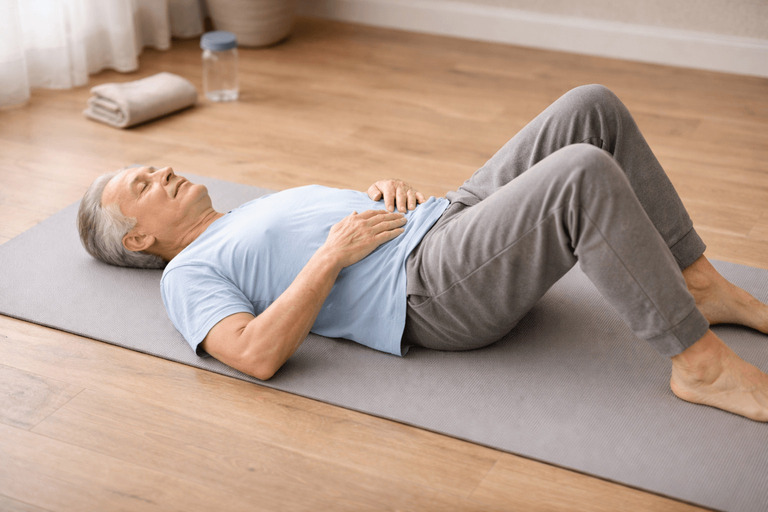
- 1.Lie on your back with knees bent, feet flat on floor
- 2.Tilt your pelvis: arch your lower back (anterior tilt) and flatten it against floor (posterior tilt)
- 3.Notice which direction feels more comfortable
- 4.If arching feels easier, arch your lower back gently. Press your feet into the floor as if trying to arch more, using only 30-40% effort
- 5.Hold 3-5 seconds, release completely. Let your back settle naturally
- 6.Repeat 2-3 times
Spinal Twist
- 1.Lie on your back with knees bent
- 2.Let both knees fall gently to the left, then to the right. Notice which direction feels easier
- 3.Let your knees rest in the easier direction
- 4.Place your hand on your upper knee. Gently try to twist further while your hand provides light resistance
- 5.Hold 3-5 seconds, release completely. Return to center and rest
- 6.Repeat 2-3 times
For Hip and Leg Issues
Hip Rotation Exercise
- 1.Lie on your back with one knee bent, foot flat on floor
- 2.Let your bent knee fall inward (internal rotation) and outward (external rotation). Notice which feels easier
- 3.If external rotation feels easier, let your knee fall gently outward
- 4.Place your hand on the inside of your knee. Gently try to let your knee fall further outward while your hand provides light resistance
- 5.Hold 3-5 seconds, release completely. Repeat 2-3 times per leg
Standing Weight Shift
- 1.Stand with feet hip-width apart
- 2.Shift your weight gently: forward to toes, back to heels, left foot, right foot
- 3.Notice which direction feels most comfortable and balanced. Shift your weight there
- 4.Press your opposite foot lightly into the ground as if trying to shift more weight to the comfortable side
- 5.Hold 3-5 seconds while maintaining balance. Release and let your weight distribute naturally
- 6.Repeat 2-3 times
A Complete Sotai Daily Routine
This 15-minute routine addresses the whole body using Sotai principles. Do it in the morning to start your day balanced, or in the evening to release accumulated tension.
Part 1: Lying Down (5 minutes)
Start lying on your back on a comfortable surface like a yoga mat, carpet, or even your bed.
- •Pelvic Assessment (1 min): Tilt pelvis anterior and posterior. Notice easier direction. Engage toward easier direction with 30-40% effort. Hold 3-5 seconds, release, repeat 3 times.
- •Leg Length Balance (1 min): Notice if one leg feels longer. Extend the longer-feeling leg. Gentle resistance, hold, release. Repeat 3 times.
- •Spinal Twist (2 min): Knees bent, let fall left and right. Rest in easier direction. Gentle resistance trying to go further. Hold, release, repeat 3 times each side.
- •Hip Rotation (1 min): One knee bent, rotate in and out. Move to easier direction. Add resistance, hold, release. Repeat 3 times per leg.
Part 2: Sitting (5 minutes)
Sit forward on a sturdy chair with good posture.
- •Neck Rotation (1 min): Turn left and right. Turn toward easier side. Add resistance with hand. Hold 3-5 seconds, release, repeat 3 times.
- •Neck Tilt (1 min): Tilt forward and back. Move to easier direction. Resist with hands. Hold, release, repeat 3 times.
- •Shoulder Elevation (1 min): Lift shoulders up. Notice easier side. Lift against gentle resistance. Hold, release, repeat 3 times.
- •Shoulder Blade Movement (2 min): Squeeze together and spread apart. Move toward comfortable direction. Add gentle resistance. Hold, release, repeat 3 times.
Part 3: Standing (5 minutes)
Stand with feet hip-width apart, near a wall for support if needed.
- •Weight Shift (2 min): Shift weight forward, back, left, right. Find most comfortable position. Press into that direction gently. Hold, release, repeat 3 times.
- •Arm Elevation (2 min): Raise both arms, notice easier side. Raise easier arm comfortably. Try to lift higher against gentle resistance. Hold, release, repeat 3 times per arm.
- •Whole Body Balance (1 min): Stand naturally. Notice any asymmetry. Shift weight to more comfortable configuration. Gentle engagement. Hold, release, repeat 3 times.
Final Rest: Stand or sit quietly for 30-60 seconds, noticing how your body feels. You should feel more balanced, relaxed, and aligned.
Advanced Sotai Concepts
Once you're comfortable with basic Sotai, these advanced concepts can deepen your practice.
Breathing Integration
Sotai traditionally incorporates specific breathing patterns:
- •For contractive movements (movements that bring body parts toward center): Inhale during the resistance phase, exhale completely during release
- •For expansive movements (movements that extend or open): Exhale during resistance, inhale during release
The "Yurashi" or Gentle Oscillation
After the release phase, some Sotai practitioners add tiny, gentle oscillations:
- 1.Complete the standard hold-and-release
- 2.While still in the released position, add barely perceptible movements
- 3.Think of jiggling Jell-O, very slight and soft oscillations
- 4.Continue for 10-20 seconds. This can enhance the nervous system reset
Application: After releasing from a neck rotation, make tiny "yes-yes" nods or "no-no" shakes. The movements should be so small they're almost invisible.

Sequential Release
For complex issues, work from the ground up:
- 1.Start with feet and ankles
- 2.Progress to knees and hips
- 3.Move to lower back
- 4.Address upper back and shoulders
- 5.Finish with neck and head
This bottom-up approach ensures that fixes in one area don't compensate for restrictions elsewhere.
When and How to Use Sotai
Best Times to Practice
- •Morning: Sets you up for the day. Focus on standing exercises. Your body is naturally stiffer, making it an ideal time to reset patterns.
- •Evening: Helps release accumulated tension. Focus on lying-down exercises. Particularly effective for improving sleep quality.
- •Before Activities: A brief session before golf, gardening, or other physical activities can prepare your body and reduce injury risk.
- •After Sitting: If you've been sitting for extended periods, even 3-5 minutes of hip and back exercises can make a significant difference.
- •During Pain Episodes: When acute pain strikes, gentle Sotai can often provide immediate relief. Use even less effort than usual (20-30%).
Frequency Guidelines
- •Daily Practice: A full 15-20 minute routine daily is ideal. Think of it as brushing your teeth for your musculoskeletal system.
- •Multiple Short Sessions: If time is limited, do 5 minutes in the morning and 5 minutes in the evening. Quality matters more than duration.
- •Spot Treatment: When specific issues arise, do targeted exercises 2-3 times throughout the day.
- •Intensive Practice: During recovery from injury or chronic issues, you might practice specific exercises 3-5 times daily. Always stay well within comfortable ranges.
Combining Sotai With Other Practices
- •With Walking: Do 5 minutes of Sotai before walking to improve gait and balance. Do 3 minutes after to release any new tension.
- •With Yoga: Use Sotai as a warm-up before yoga to identify and address imbalances.
- •With Strength Training: Sotai before strength training can improve form and reduce injury risk. Sotai after can help recovery.
- •With Do-In Acupressure: These two Japanese practices complement each other beautifully. Do-In addresses energy flow through specific points. Sotai addresses neuromuscular patterns through movement.
Understanding the Sotai Response
Signs You're Doing It Right
- Movements feel natural and easy
- You can breathe comfortably throughout
- You feel better after than before
- Restrictions reduce noticeably
- You feel more balanced and centered
- Effects last beyond the session
Signs to Adjust Your Approach
- Movements feel forced or uncomfortable
- You're holding your breath
- Pain increases during or after
- You feel worse than before starting
- No noticeable change even after multiple sessions
If you notice these warning signs, reduce your effort level, move even more gently, and consider working with a trained Sotai practitioner.
Common Mistakes and How to Avoid Them
Using Too Much Force
Many people, accustomed to "no pain, no gain" stretching, use 70-80% effort. This triggers defensive muscle tension. Solution: Consciously reduce effort to 30-40% maximum. If you're grimacing or holding your breath, you're using too much force.
Holding Too Long
Holding longer than 5 seconds causes muscles to fatigue rather than reset. Solution: Keep holds to 3-5 seconds maximum. The release response is what creates change.
Gradual Release
Slowly reducing pressure prevents the nervous system reset. Solution: Release all at once, suddenly but not violently. Think of it like turning off a light switch, definite and complete.
Moving Toward Pain
Old habits die hard. Many people instinctively move toward restriction. Solution: Consistently remind yourself: "Move toward comfort, not pain." Think of Sotai as "celebrating what works" rather than "fixing what's broken."
Skipping the Assessment
Jumping straight into exercises without testing which direction feels easier. Solution: Always assess first. Your body's preferences change daily, even hour to hour.
Forcing Symmetry
Trying to make both sides equal through sheer repetition. Solution: Trust the process. Work with the easier side and allow natural rebalancing. Forced symmetry often creates new compensations.
The Science Behind Sotai
While traditional Sotai was developed through clinical observation, modern science is beginning to explain why it works so well.
Neuroplasticity and Pattern Reset
Sotai works primarily through the nervous system rather than through mechanical stretching of tissues. When you move in a comfortable direction and add gentle resistance, you're creating new neural patterns. The sudden release triggers a "reset" response, allowing old compensatory patterns to dissolve. Research on neuroplasticity shows that the nervous system is constantly updating movement patterns based on experience. Sotai provides clear, comfortable experiences that the nervous system readily adopts.
The Relaxation Response
The sudden release after gentle engagement triggers the parasympathetic nervous system, your body's "rest and digest" mode. This creates a cascade of beneficial effects:
- •Reduced muscle tension
- •Improved circulation
- •Decreased pain perception
- •Enhanced tissue healing
- •Reduced stress hormones
Proprioceptive Recalibration
Proprioception is your sense of where your body is in space. Chronic tension and imbalance distort proprioception. You literally lose accurate perception of your body's position. Sotai recalibrates this sense by providing clear, comfortable feedback, resetting muscle tension to more normal levels, and allowing natural posture to emerge.
Fascial Release
Recent research on fascia (connective tissue) suggests it plays a major role in movement patterns and pain. The gentle engagement and release of Sotai appears to affect fascial tension, allowing more fluid movement. Unlike aggressive fascial work, Sotai's gentle approach works with the fascia's natural tendency toward balance and integration.
Beyond Physical Benefits
Regular practitioners often report benefits that extend well beyond the body:
- •Mental Clarity and Focus: The mindful attention required for Sotai develops present-moment awareness, improving concentration and reducing mental chatter.
- •Emotional Release: Chronic muscle tension often has emotional components. When Sotai releases long-held patterns, emotions that were "locked in" may surface naturally and healthily.
- •Body Trust and Confidence: Sotai's consistent experience of comfortable movement and positive results rebuilds trust in your body's wisdom and resilience.
- •Stress Reduction: The combination of gentle movement, mindful attention, and consistent positive results makes Sotai an effective stress management tool.
- •Better Sleep: Many practitioners report improved sleep quality, likely due to reduced physical discomfort, lower stress levels, and activated parasympathetic nervous system.
Safety Considerations
Safe for
- Chronic muscle tension and stiffness
- Postural imbalances
- Recovery from minor injuries (after acute phase)
- Prevention and maintenance
- Age-related stiffness
- Stress-related muscle tension
- Mild to moderate back, neck, shoulder, and hip pain
Consult a healthcare provider first if you have
- •Acute injuries (within first 72 hours)
- •Severe osteoporosis
- •Recent surgery
- •Undiagnosed severe pain
- •Herniated discs with nerve symptoms
- •Unstable joints or active inflammation
- •Neurological conditions
Special Considerations for Seniors
Sotai is ideal for seniors due to its gentleness. Move even more slowly, use chairs or walls for support, reduce effort to 20-30% if needed, practice seated versions when balance is a concern, and never sacrifice stability for movement.
Sotai for Specific Conditions
Chronic Neck Pain
Often involves rotation restriction and forward head posture. Daily neck rotation exercise (toward easier side), neck extension work, shoulder blade exercises, and full-body standing exercises to address the whole postural pattern.
Timeline: Many notice improvement within 1-2 weeks, with significant change in 4-6 weeks.
Lower Back Stiffness
Often involves pelvic tilt restriction and asymmetrical leg length sensation. Daily pelvic tilt exercise, leg length balancing, hip rotation work, spinal twist exercises, and standing weight shift for integration.
Timeline: Immediate relief is common, with lasting improvement over 2-4 weeks.
Shoulder Tension and Restricted Mobility
Often one shoulder higher than the other, restricted overhead reaching. Shoulder elevation exercises, arm rotation work, shoulder blade movement, and neck exercises (shoulder and neck are interconnected).
Timeline: Noticeable improvement often within a week, with full resolution in 3-6 weeks.
Poor Posture and Balance
Forward head, rounded shoulders, anterior pelvic tilt, poor balance. Full-body assessment and whole-body exercises, sequential work from feet to head, standing balance exercises.
Timeline: Gradual, progressive improvement over 6-12 weeks, with ongoing enhancement.
Integrating Sotai Into Daily Life
The real power of Sotai emerges when it becomes a natural part of your daily routine:
- •Morning Ritual: While still in bed, do leg length balancing. Sitting on edge of bed, do neck rotations. Standing, do weight shift exercises. Start your day feeling balanced.
- •During Work Breaks: Every hour, do neck rotation and tilt exercises (30 seconds). Mid-morning and mid-afternoon, do shoulder exercises (2 minutes). Before lunch, do standing weight shift (1 minute).
- •Evening Wind-Down: Lying in bed, do pelvic tilts and spinal twists (3 minutes). Sitting on edge of bed, do shoulder and neck releases (2 minutes). End with leg length balancing for restful sleep.
- •Pre-Activity Preparation: Before golf, gardening, or other activities, do a full-body assessment and address any restrictions found. Takes just 5 minutes.
Frequently Asked Questions
Is Sotai safe for seniors with arthritis? ▼
Yes, Sotai can be very helpful for arthritis due to its gentleness. Use minimal effort, practice shorter and more frequent sessions, and some days you may need to practice very gently or skip entirely. Track which exercises help most and always stay within comfortable ranges.
How is Sotai different from regular stretching? ▼
Regular stretching pulls tight muscles toward their limit, which can trigger defensive tension. Sotai does the opposite. You move in the comfortable direction with gentle resistance, then release suddenly. This allows your nervous system to reset without triggering a protective response, often achieving better results with less effort.
How quickly can I expect results? ▼
Many people notice immediate improvement in range of motion and pain reduction after a single session. For lasting changes, expect noticeable improvement within 1-2 weeks of daily practice, with significant results in 4-6 weeks. Complex or chronic issues may take longer.
Can I do Sotai on my own, or do I need a practitioner? ▼
Sotai is designed for self-practice. All the exercises in this article can be done alone, though working with a trained practitioner can accelerate your progress, especially for complex or severe issues. Consider professional guidance if self-practice isn't producing expected results.
What if both directions feel equally comfortable (or uncomfortable)? ▼
If both directions feel equal, choose either one. Your body may be relatively balanced in that area. If both feel uncomfortable, start with the one that feels slightly less uncomfortable and use even less effort (20-30%). Sometimes the difference is very subtle and becomes clearer with practice.
How does Sotai compare to Makko-Ho stretching? ▼
Makko-Ho uses sustained forward-fold stretches along meridian lines, while Sotai uses brief, gentle resistance in comfortable directions. They complement each other well: Makko-Ho for systematic flexibility, Sotai for pain relief and nervous system rebalancing. Many people benefit from practicing both.
Why Sotai Is Perfect for Seniors Over 50
No Pain Required
You always move toward comfort, never through pain.
Minimal Effort
Only 30-40% effort means anyone can participate safely.
No Equipment Needed
Practice anywhere with just your body and a chair for support.
Self-Correcting
You control the movement, so it's impossible to push too hard.
Immediate Results
Most people feel improvement after a single session.
Addresses Root Causes
Resets nervous system patterns rather than just treating symptoms.
Trusting Your Body's Wisdom
Sotai offers something rare in modern health care: a simple, gentle, effective method that trusts your body's innate wisdom. In a world of aggressive treatments and forcing change, Sotai takes a revolutionary, common-sense approach: move toward comfort, engage gently, release completely, allow natural rebalancing.
You don't need expensive equipment, a gym membership, or even much time. Just 10-15 minutes a day of mindful, gentle movement in comfortable directions can transform chronic pain, improve posture, enhance balance, and restore natural, efficient movement.
Perhaps most importantly, you'll develop a new relationship with your body, one based on listening, trust, and cooperation rather than force and control. Your body already knows how to heal and balance itself. Sotai simply creates the conditions that allow this natural wisdom to emerge.
Start small. Choose one exercise from this article that addresses your main concern. Practice it daily for a week. Notice what changes. Let your body guide you to what it needs. Your body has been waiting patiently for you to work with it rather than against it. Sotai is your invitation to begin that collaboration.
Medical Disclaimer
This article is for informational purposes only and should not replace professional medical advice. Consult with your healthcare provider before beginning Sotai practice, especially if you have acute injuries, joint conditions, neurological conditions, or other health concerns. If you experience increased pain during practice, stop immediately and seek professional guidance. Sotai should always feel comfortable. Never force through pain.